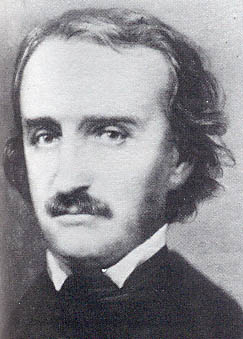
Find out more about Poe
|
Edgar Allan Poe 'Poe himself would get caught up in the poem's haunting verses. His one-time fiance, Elmira Royster, described one of Poe's
performances: "When Edgar read THE RAVEN, he became so wildly
excited that he frightened me, and when I remonstrated with him
he replied he could not help it - that it set his brain on fire."
 Edgar Poe was born in Boston in 1809, the son of itinerant actors.
His father died the year after he was born, and, when his mother died
a year later, young Edgar was taken into the home of a successful
Richmond, Virginia merchant, John Allan. While Allan provided for
the child, Poe's relationship with his guardian was strained. Allan
urged his ward to pursue a legal career. Poe, however, insisted on
writing. Edgar Poe was born in Boston in 1809, the son of itinerant actors.
His father died the year after he was born, and, when his mother died
a year later, young Edgar was taken into the home of a successful
Richmond, Virginia merchant, John Allan. While Allan provided for
the child, Poe's relationship with his guardian was strained. Allan
urged his ward to pursue a legal career. Poe, however, insisted on
writing.
In one last attempt to reconcile himself to Poe, Allan obtained an
appointment for Edgar at West Point. The attempted reconciliation
came to naught. In 1830, Poe was dishonorably discharged for
intentional neglect of his duties, and the dismissal completely
severed his relations with Allan.
Poe quickly focused himself on his writing. His tales of the
macabre and grotesque soon caught the imagination of the public,
but nothing could match the overwhelming reception of his most
famous poem. With its eerie images, its dark themes of obsessive
love and its hypnotic rhymes and rhythms, THE RAVEN, published in
LE CORBEAU ... THE RAVEN 1845, took the nation by storm. The poem
spawned countless imitations and Poe himself was in constant demand
for readings.
The success of THE RAVEN, however, brought little relief to Poe's
tumultuous life. Lacking regular employment and plagued by his
addiction to alcohol, Poe was soon virtually penniless. When his
wife died of tuberculosis in 1845, he spiraled further into
depression. In Baltimore in 1849, Poe was found wandering the
streets in a state of delirium. He died four days later. |