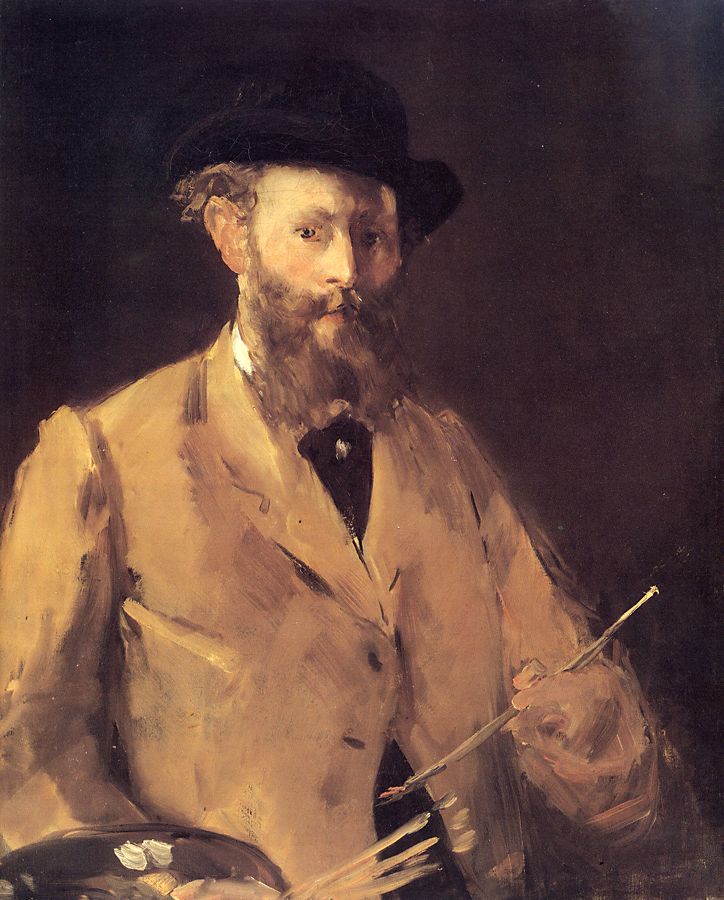
"Paint the truth and let them chatter."
 Few painters have suffered as controversial a career as
Edouard Manet (1832 - 1883), the artist often cited as the
founder of modern painting. His work was bold and unsentimental,
and his contemporaries found it shocking.
Few painters have suffered as controversial a career as
Edouard Manet (1832 - 1883), the artist often cited as the
founder of modern painting. His work was bold and unsentimental,
and his contemporaries found it shocking.
Although Manet's work was strikingly different from the other art
of his day, Manet himself was thoroughly schooled in the work of
the old masters. He spent six years studying under Thomas Couture
arduously copying the work of Rembrandt, Titian and Veldzquez.
Manet's first success came at the Salon of 1861. His painting,
The Spanish Singer, was not only accepted, but won an honorable
mention. Nevertheless, there were already those who resisted
Manet's vision. "What poetry in the idiotic mule-driver figure,
in the blank wall, in the onion and the cigarette butt," wrote
one critic. "What a scourge to society is a realist painter,"
wrote another. Despite the attacks, Manet relished the official
recognition conferred by the Salon, and he would continue to seek
that official blessing throughout his life.
If Manet's critics had been offended by The Spani5h Singer,
they were completely scandalized by Olympia, the nude portrait
Manet considered his masterpiece. Though evocative of Goya and
Titian, Olympia's hardedged realism shocked the audiences of its day.
Rather than presenting a nude as a perfect form or setting it in a
mythological context, Manet offered a bold, frank portrait, shocking
in its perspective and style, of a prostitute waiting for a client.
Surprisingly, the work was accepted for the Salon of 1865. Audiences
and critics, however, were unprepared for such a work. "Abuses
rain upon me like hail," Manet wrote. His work was reviled as a
"terrible canvas"; his model as "vile" and "wretched." "The crowd,
as at the morgue, presses together in front of the gamy Olympia."
The work displayed "an almost childish ignorance of the first
elements of drawing" and Manet "a bent for unbelievable vulgarity."
A hero of the avantgarde, the artist was accused of being
deliberately provocative.
"How foolish must one be to say I'm trying to fire pistol shots,"
Manet responded. "I render, as simply as can be, the things I see.
Take Olympia, could anything be plainer? There are hard parts, I'm
told. They were there. I saw them. I put down what I saw."
Manet's work continued to surprise and challenge audiences for
the rest of his career.